
Cover Story Logic – Simple, Credible, Repeatable
A cover story is not a complex lie. It is a simple, credible, and repeatable explanation for your presence or actions that satisfies casual inquiry without revealing your true intent. In both protective operations and sensitive travel, a well constructed cover provides a vital layer of operational security by deflecting attention and avoiding unnecessary conversations. The goal is not to deceive with elaborate fiction but to manage perceptions with a bland and uninteresting truth. A good cover story is built on elements of reality, is easy to remember, and withstands mild scrutiny. This practice is about maintaining privacy and control over information, not about breaking the law or evading legitimate authority. Developing this skill requires understanding the core principles of
A weak cover story creates more suspicion than no story at all. The moment you have to think about your answer, you have already lost. Your explanation must be automatic, boring, and utterly forgettable to the person who hears it.
The Foundation of a Believable Narrative
Every effective cover story rests on a foundation of simplicity. The narrative should be so straightforward that you can recall every detail without conscious effort under stress. Complex lies require perfect memory and create opportunities for contradiction. A simple story about visiting a client, attending a conference, or exploring local history is easily digestible and quickly forgotten by the listener. It answers the question without inviting further discussion because it is so ordinary.
Credibility is the next critical pillar. Your cover must align with your appearance, demeanor, and the environment. A cover about being a wildlife photographer requires carrying appropriate equipment and demonstrating basic knowledge of the craft. Your story should weave in true elements, such as your actual hometown or a real company you have worked for in the past, to make the fiction more grounded. This approach minimizes the cognitive load of maintaining the cover and makes your responses more natural and convincing.
The final pillar is repeatability. You must deliver the exact same details every time you are asked, whether by a hotel clerk, a curious local, or a fellow passenger. Any deviation from the script can raise doubts. Write down the key points of your cover and memorize them until they become second nature. This consistency is what makes the story hold up and prevents small mistakes from unraveling your operational security. A repeatable story is a secure story.
Constructing Your Cover Identity
Your cover identity begins with your appearance. Dress appropriately for the role you are claiming. A consultant traveling for business should look the part, not like a backpacker on vacation. Your clothing, luggage, and even reading material should support your stated purpose. These visual cues are often more believable than anything you say. People will believe what they see before they believe what they hear, so your visual profile must be congruent with your story.
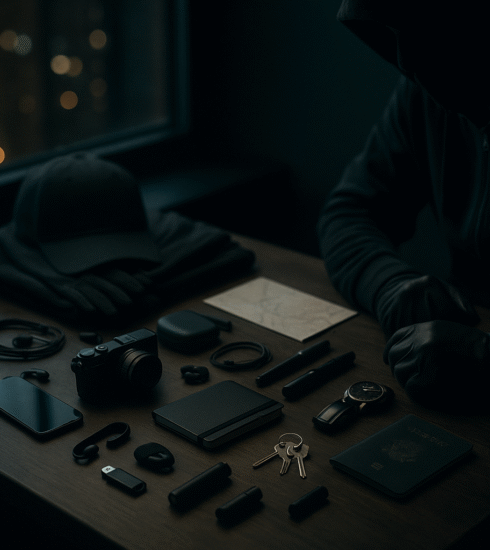
Supporting artifacts lend powerful authenticity to your cover. These are physical items that corroborate your narrative. A map from a local tourist attraction, a lanyard from a plausible conference, or business cards for your cover occupation can all sell the story without a single word being spoken. These items should be readily available but not ostentatiously displayed. They exist to be discovered incidentally, providing passive validation to anyone who might be casually observant.
Digital artifacts are equally important in the modern world. Your smartphone and laptop should reflect your cover story. The websites in your browser history, the apps on your home screen, and the files on your desktop should all align with your claimed activities. This is not about creating a deep digital fake but about maintaining basic consistency. A real estate developer would not have a browser full of tabs about amateur astronomy. This holistic attention to detail makes your cover resilient.
Always have a reason for being somewhere that has nothing to do with why you are actually there. Your cover should explain your presence in the area, not just at a specific site. A story about bird watching explains why you are in a rural park, not why you are parked on a specific overlook.
Anticipating and Deflecting Questions
A strong cover story anticipates natural human curiosity and preempts it. Think like the people you will encounter and prepare answers for the questions they are most likely to ask. Where are you from? What brings you to town? How long are you staying? These are standard polite inquiries that require smooth, rehearsed answers. Your responses should be friendly but brief, offering just enough information to satisfy curiosity and then redirecting the conversation.
Deflection is a key skill when faced with unexpected or probing questions. The best method is to answer the question briefly and then immediately ask a related question back to the other person. People generally enjoy talking about themselves, and this technique smoothly shifts the focus away from you. If someone asks about your business, give your rehearsed answer and then immediately ask about local industry or their own line of work. This maintains a friendly interaction while protecting your information.
You must also prepare for more specific technical questions related to your cover profession. If you claim to be in a certain field, you must possess a baseline knowledge of its jargon and current events. This does not require expert level understanding but enough to sound conversational and credible. Spending an hour researching the basics of your cover job online can provide enough material to handle casual chats. This preparation prevents you from being exposed by a simple question from a genuine enthusiast.
Cover for Actions, Not Just Identity
A cover story often needs to explain not just who you are but what you are doing. Your behavior might seem unusual or noteworthy to an observer, and a simple explanation can normalize it. Repeatedly driving through a neighborhood might look suspicious without a context like doing deliveries for a food app or training for a delivery driver job. The cover for your actions should be as simple and boring as the cover for your identity.
Timing and patterns are critical here. Your cover action must align with reasonable patterns of life. Conducting surveillance detection routes in the middle of the night is harder to explain than doing them during daytime business hours. Your story should account for why you are in an area at a specific time. A cover about being a freelance writer seeking inspiration explains a meandering walk through a city at various hours far better than a story about having a standard nine to five job.
The principle of deniability is important for action covers. Your explanation should provide a plausible reason for your behavior that is difficult to disprove. Claiming to be a geography student studying urban planning allows for a wide range of observant behaviors in a city environment. It explains note taking, photography, and loitering without drawing attention to more sensitive purposes. The cover makes your actions appear ordinary and academic rather than operational.
Training and Maintaining Your Cover
A cover story is a skill that requires practice to maintain effectively. You should rehearse your story aloud until it flows naturally without hesitation. Practice with a trusted partner who can ask challenging questions and point out inconsistencies in your delivery. This rehearsal builds the muscle memory needed to deliver the cover convincingly under pressure when you might be tired or stressed. The story should feel as comfortable as telling your real biography.
Mental compartmentalization is essential for long term cover maintenance. You must be able to switch into your cover identity when needed and then switch back just as easily. This is not about developing a split personality but about consciously adopting a specific mindset for a specific context. This ability to mentally transition helps prevent slips where you might accidentally reference real details that contradict your cover story. It keeps the two worlds separate and secure.
Finally, know when to abandon a cover. If you sense that your story is not being believed or that you are under more than casual scrutiny, it is often safer to withdraw entirely than to try to reinforce a failing narrative. The goal is avoidance of attention, not winning an argument. Having an exit strategy and a reason to abruptly leave a conversation is part of a well planned cover. Sometimes the most credible thing you can do is be forgettably normal, and that includes having normal reasons to end interactions.
The logic of a cover story is ultimately about control. It is about controlling the narrative around your presence and activities to protect your actual mission, which may be as simple as enjoying private travel. By making your story simple, credible, and repeatable, you blend into the background and avoid becoming a person of interest. This is a lawful and practical skill that enhances personal security through smart preparation rather than deception.